How Much Are Silver Certificates Worth? A Complete Valuation Guide
One of the most common questions about silver certificates is a simple one: what are they actually worth? The answer depends on several factors, and the range is wider than most people expect. A common circulated example might be worth just a few dollars above face value, while rare varieties in top condition can sell for hundreds or more. This guide covers the key factors that determine silver certificate values across denominations and series.
Introduction
Silver certificates are no longer redeemable for silver, but they retain real value as collectibles. Most people encounter them through inheritances, old collections, or chance finds — and most want to know quickly whether what they have is common or something special.
The short answer for most silver certificates is that common circulated examples are worth modestly above face value, while condition, denomination, series, and certain identifying features can push values significantly higher. Understanding the variables is the first step to an accurate assessment.
Face Value vs. Collector Value
Every silver certificate is worth at least its face value as legal tender. A $1 silver certificate can be spent as a dollar; a $5 note as five dollars. In practice, spending one would be a poor decision — virtually all silver certificates in identifiable condition are worth more than face value to a dealer or collector.
The floor for most common silver certificates is typically a modest premium above face value. A heavily worn 1957 $1 note, for example, might trade for $1.25 to $2.00. The ceiling for rare, high-grade, or historically significant examples is substantially higher.
The Role of Condition
Condition is arguably the single most important factor in determining value for common series. Paper currency is graded on a scale from Poor (P-1) through Gem Uncirculated (MS-68 or higher), with key grades including:
- Very Fine (VF-20 to VF-35) — Light folds, bright colors, generally presentable. Most silver certificates found in old collections fall in this range.
- Extremely Fine (EF-40 to EF-45) — Minor folds only, strong colors and detail. Noticeably better than average.
- About Uncirculated (AU-50 to AU-58) — Slight handling only, nearly pristine.
- Uncirculated (MS-60 and above) — No folds, no handling. Original crispness. Certified examples graded MS-63 and higher command meaningful premiums.
For common series like 1957 and 1935, the difference between a circulated example and a certified gem uncirculated one can be the difference between $2 and $50 or more. For scarce series, that gap widens considerably.
$1 Silver Certificate Values by Series
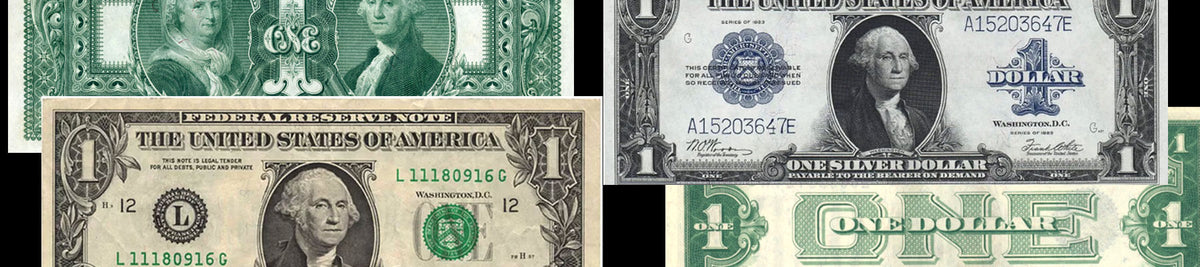
The $1 denomination accounts for the vast majority of silver certificates encountered today. Values vary by series:
- Series 1957, 1957A, 1957B — The most common silver certificates in existence. Circulated examples typically trade for $1.50 to $3.00. Uncirculated examples range from $5 to $15 for average grades; certified gem examples can reach $30 to $60.
- Series 1935 through 1935H — Also very common in circulated condition. Values are similar to 1957 notes for most sub-series. The 1935A "R" and "S" experimental notes are exceptions, with values starting around $75 to $100 for circulated examples and climbing significantly for higher grades.
- Series 1928 through 1928E — Early small-size notes from the first post-redesign series. Less common than 1935 and 1957 notes; circulated examples typically start at $10 to $20, with uncirculated examples ranging higher depending on sub-series.
- Large-size notes (pre-1928) — Values vary widely. Common large-size $1 silver certificates in circulated condition start around $30 to $60; rarer designs and higher grades can reach several hundred dollars or more.
$5 Silver Certificate Values
$5 silver certificates are considerably less common than $1 notes and carry higher base values across the board.
Circulated examples from common small-size series such as Series 1934 and Series 1953 typically trade in the $8 to $20 range. Uncirculated examples start higher, and certified high-grade notes can reach $50 to $150 depending on the specific series and grade.
Earlier small-size series and large-size $5 silver certificates command greater premiums. Large-size $5 notes in collectible condition often start at $50 to $100 and climb significantly for finer examples.
$10 Silver Certificates and Higher Denominations
$10 silver certificates follow a similar pattern, with circulated small-size examples from common series starting in the $15 to $30 range. Higher denominations — $20, $50, and $100 — were also issued but are considerably scarcer and generally command prices starting well above face value even in circulated condition.
The large-size $10, $20, $50, and $100 silver certificates are collector items across the board. Even heavily worn examples in these denominations attract meaningful collector interest.
Star Notes and Their Premium
Star notes are replacement notes — printed to substitute for notes that were damaged or destroyed during the production process. They are identifiable by a star symbol (★) at the end of the serial number rather than a letter suffix.
Star notes are printed in smaller quantities than regular notes, making them scarcer by definition. A star note from any series typically commands a premium over the equivalent regular note. For common series like 1957 and 1935, the premium may be modest — perhaps $5 to $20 over regular note prices at comparable grades. For scarce series or high-grade certified examples, star note premiums can be substantial.
What Reduces Value
Certain conditions significantly reduce the value of a silver certificate:
- Tears, holes, or missing corners — Damage of this type substantially discounts value regardless of series
- Writing or stamps on the note — Any ink markings reduce collector interest
- Tape or repair — Paper repairs are typically deal-breakers for serious collectors
- Staining or washing — Water damage or cleaning attempts are immediately apparent to experienced buyers
A note with any of these issues will likely trade at or near face value regardless of series or denomination.
Getting an Accurate Value
The most reliable way to assess value is to compare against recent sold listings on established currency marketplaces, or to have the note examined by a professional currency dealer. Third-party grading services such as PCGS Currency and PMG (Paper Money Guaranty) provide certified grades and encapsulation for notes where the cost of grading is justified by the potential value.
For common circulated examples, grading services are generally not cost-effective. For anything potentially scarce, uncirculated, or showing characteristics that suggest premium value, professional assessment is worthwhile.
Conclusion
Most silver certificates found in circulation or old collections are common examples worth a modest premium above face value. Condition, denomination, series, and star note status are the primary drivers of value above that baseline. Rare series, high-grade certified examples, and specialty issues like experimental or wartime notes occupy their own market at significantly higher price points. Knowing the basics of these variables allows any holder to make a reasonable initial assessment of what they have.