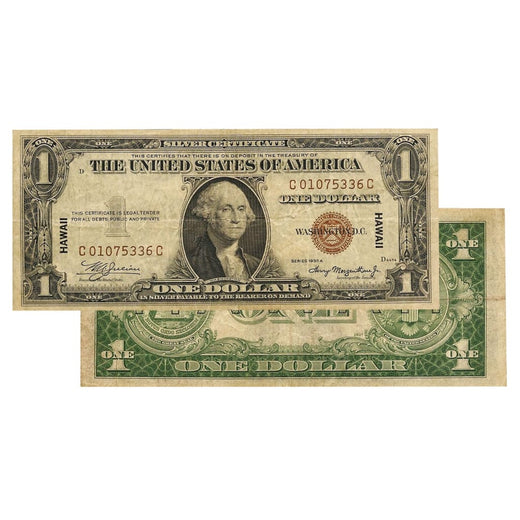
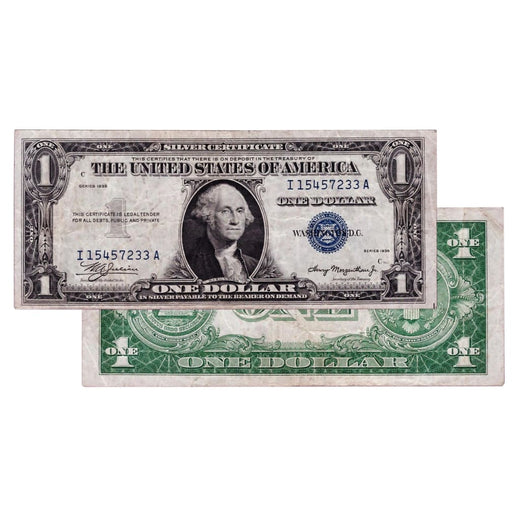
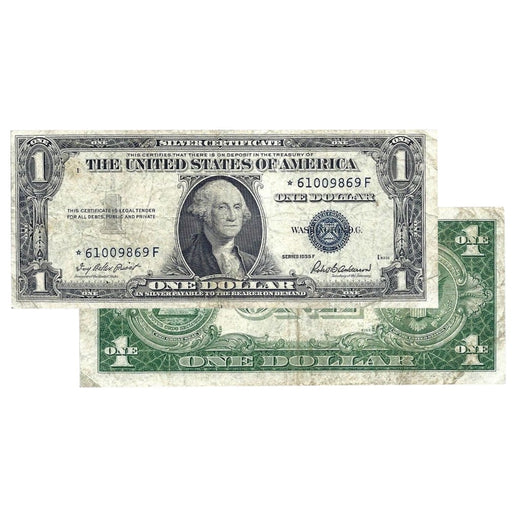
The Series 1935 $1 silver certificate is the most commonly encountered silver certificate in existence. Billions were printed across multiple sub-series spanning more than two decades, and many survived in decent condition. Yet within that abundance lies real variety — certain sub-series are notably scarcer, specific experimental issues carry significant premiums, and condition still separates common examples from genuinely desirable ones.
What Is a Series 1935 Silver Certificate?
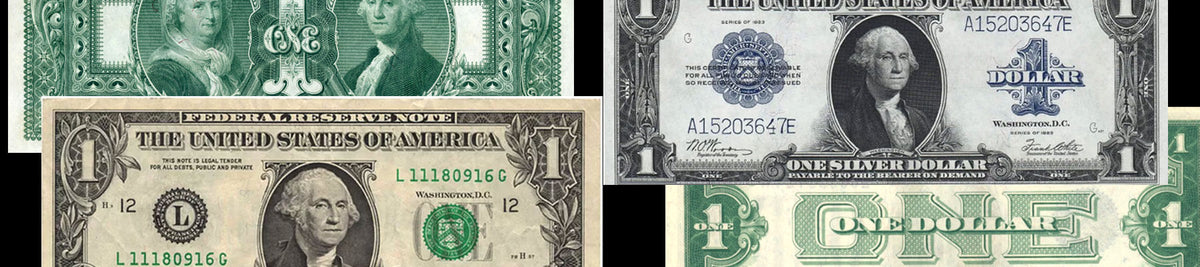
The Series 1935 $1 silver certificate was issued by the United States Treasury as part of the small-size currency format standardized in 1928. It features the portrait of George Washington on the obverse, the same design used on the $1 Federal Reserve Note today, and carries the characteristic blue treasury seal and blue serial numbers that identify all silver certificates.
The series was produced across eight sub-series — 1935, 1935A, 1935B, 1935C, 1935D, 1935E, 1935F, 1935G, and 1935H — with production continuing from the mid-1930s through 1953. Each sub-series reflects a different combination of Treasury signatures and, in some cases, design modifications.
The Sub-Series Breakdown
Understanding the sub-series is essential for accurate valuation, as print runs and survival rates vary considerably.
- Series 1935 — The original issue. Signatures of Julian and Morgenthau. Produced in substantial quantities; circulated examples are common. Uncirculated examples carry a modest premium.
- Series 1935A — The most widely produced sub-series and the most commonly encountered today. Also carries Julian/Morgenthau signatures. Standard 1935A notes are abundant. However, this sub-series also includes the famous "R" and "S" experimental notes — see below.
- Series 1935B — Julian/Vinson signatures. Less common than 1935 or 1935A; circulated examples start somewhat higher than the most common sub-series.
- Series 1935C — Julian/Snyder signatures. Production numbers were lower than 1935A; somewhat less common in all grades.
- Series 1935D — Clark/Snyder signatures. One of the more commonly encountered mid-series sub-series. Wide and narrow back varieties exist within 1935D, with the narrow back being scarcer.
- Series 1935E — Priest/Humphrey signatures. Commonly encountered in circulated grades.
- Series 1935F — Priest/Anderson signatures. Less common than 1935E; circulated examples command a small premium.
- Series 1935G — Smith/Dillon signatures. Produced in smaller quantities; among the scarcer standard sub-series.
- Series 1935H — Granahan/Dillon signatures. The final 1935 sub-series. Relatively scarce compared to the early sub-series.
The 1935A "R" and "S" Experimental Notes
The most significant varieties within the entire 1935 series are the 1935A "R" and "S" experimental notes. These were issued by the Treasury in the mid-1940s to test two different paper stocks — one regular (designated "S" for Special) and one experimental (designated "R" for Regular, counterintuitively). A red letter "R" or "S" was overprinted on the face of the note to distinguish the two types.
Print runs for both were limited. Approximately 1.2 million "S" notes and 1.184 million "R" notes were produced — a tiny fraction of the billions of standard 1935A notes printed. Both varieties command substantial premiums over standard 1935A notes.
In circulated condition, genuine "R" and "S" experimental notes typically sell for $75 to $150 or more. Fine to very fine examples fall in the $100 to $200 range, and uncirculated certified examples can reach significantly higher. The two are often collected as a matched pair, which adds further demand from completionist collectors.
Star Notes Within the 1935 Series
Star notes — replacement notes identifiable by a ★ at the end of the serial number — exist across all 1935 sub-series and carry premiums over standard examples. The degree of premium varies by sub-series.
Star notes from the common 1935A sub-series are relatively abundant and typically trade for modest premiums in circulated grades. Star notes from the scarcer sub-series such as 1935G or 1935H are genuinely uncommon and can command meaningful premiums, particularly in uncirculated condition.
Any 1935 series note with a star in the serial number warrants closer inspection before being treated as a standard example.
What Are 1935 Silver Certificates Worth?
Values for standard 1935 silver certificates follow condition closely. For the most common sub-series (1935, 1935A, 1935D, 1935E):
- Heavily circulated (Good to Fine) — $1.50 to $3.00
- Very Fine — $3.00 to $6.00
- Extremely Fine — $6.00 to $12.00
- Uncirculated (circulated-free, ungraded) — $10.00 to $25.00
- Certified gem uncirculated (PMG/PCGS MS-65 or higher) — $30.00 to $75.00+
For scarcer sub-series (1935B, 1935C, 1935F, 1935G, 1935H), values in comparable grades run somewhat higher, typically 1.5x to 3x the prices above.
For 1935A "R" and "S" experimental notes, starting prices for circulated examples are approximately $75 to $150, with higher grades climbing well above that.
How to Identify a 1935 Silver Certificate
Identifying a 1935 series note is straightforward:
- Look for "Silver Certificate" printed at the top of the face
- Confirm the blue treasury seal on the right side of the face
- Check the series year printed to the right of Washington's portrait — it will read "Series 1935" followed by a letter suffix (or no suffix for the original 1935 issue)
- Check for a star (★) in the serial number
- For experimental notes, look for a red overprinted "R" or "S" on the face of the note
How Many 1935 Silver Certificates Were Made?
Total production across all 1935 sub-series ran into the billions of notes. The 1935A sub-series alone accounted for several billion individual notes. This abundance is why common circulated examples trade at modest prices — supply far exceeds collector demand for ordinary examples.
The scarcer sub-series and specialty varieties are the exception. When production numbers were low, or when most examples were spent and lost to circulation, the surviving population of collectible notes is genuinely limited.